





fluidMAG
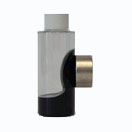
fluidMAG-nanoparticles are ferrofluids consisting of an aqueous dispersion of magnetic iron oxides with diameters of 50 nm, 100 nm and 200 nm. The particles are covered with hydrophilic polymers which protect them against aggregation by foreign ions. Terminal functional groups such as ion-exchange groups or reactive groups for covalent immobilization can be used for binding to biomolecules. Ferrofluids can further be used for MRI-diagnostics and magnetic drug targeting applications.
| Application: | Cell separation, MRI-diagnostics, Magnetic Drug-Targeting | |
| Formulation: | suspension in ddH2O, autoclaved | |
| Concentration: | 25 mg/ml | |
| Particle sizes: | 50 nm, 100 nm, 200 nm; ( 75 nm, 150 nm on request) | |
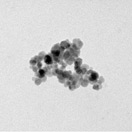
TEM-multi-domain magnetite core
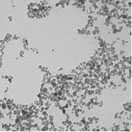
TEM-single-domain magnetite cores
fluidMAG-nanoparticles with hydrodynamic diameters of 100-200 nm have a multi-domain core and in-batch separable by a external magnetic field (magnetic separator). Therefore, a fast and easy magnetic isolation of nanoparticles is possible.
Ferrofluids with particle sizes of 50 nm have a single domain core and therefore not separable by an external magnetic field. These substances are real magnetic fluids, and the magnetic isolation is only possible with a High Gradient Magnetic Separator (e.g. Miltenyi® separation columns). This is expensive and time consuming; therefore we recommend using magnetic nanoparticles with a minimum size of 100 nm.
| Product | Polymer Matrix | Product Number | Quantity (ml) | Price EUR / USD |
Application | Product Information | Reference Number |
|---|---|---|---|---|---|---|---|
| fluidMAG-Amine | Amine silane | 4121-1 4121-5 |
1 5 |
40 / 52 160 / 208 |
For covalent coupling of biomolecules |  |
1.35,
1.48,
1.57, 1.62, 3.09, 3.18, 10.37 |
| fluidMAG-ARA | Glucuronic acid | 4115-1 4115-5 |
1 5 |
40 / 52 160 / 208 |
Weak cation exchanger; for covalent coupling of biomolecules
(antibodies or proteins) See protocol: A10 |
|
1.02,
1.13,
1.22, 1.63, 1.68, 3.04, 3.07, 3.14, 3.15, 3.16, 3.17, 3.19, 3.23, 4.05, 5.03, 5.21, 5.22, 10.34 |
| fluidMAG-Bromoacetyl* *Available only in a hydrodynamic diameter of 200 nm. |
Bromoacetyl | 4128-1 4128-5 |
1 5 |
40 / 52 160 / 208 |
For binding of SH-groups containing bioligands see coupling protocol: A14 |
|
- |
| fluidMAG-Chitosan | Chitosan | 4118-1 4118-5 |
1 5 |
40 / 52 160 / 208 |
Linear, biodegradable polymer with amino-groups | |
3.20, 3.22, 6.11 |
| fluidMAG-CMX | Carboxymethyldextran | 4106-1 4106-5 |
1 5 |
40 / 52 160 / 208 |
Weak cation-exchanger See protocol: A11 |
|
1.14,
3.18,
4.12, 5.01, 5.10, 6.05, 10.30 |
| fluidMAG-CT | Citric acid | 4122-1 4122-5 |
1 5 |
40 / 52 160 / 208 |
For MRI diagnostic and for binding of cationic molecules | |
3.10 |
| fluidMAG-D | Starch | 4101-1 4101-5 |
1 5 |
40 / 52 160 / 208 |
Isolation of lysosomes, MRI-diagnostic,
for covalent coupling of biomolecules (antibodies or proteins) See protocol: A9 |
|
1.02,
1.03,
1.20, 3.03, 3.13, 3.22, 4.01, 4.02, 4.04, 4.07, 4.10, 4.14, 5.04, 5.11, 5.15, 5.16, 5.17, 5.20, 7.03, 7.04, 7.06, 10.07, 10.15, 10.18, 10.21, 10.22, 10.30, 10.35, 10.37, 10.38, 10.40, 10.42 |
| fluidMAG-DEAE | DEAE-starch | 4102-1 4102-5 |
1 5 |
40 / 52 160 / 208 |
Binds negative groups of cells, bacteria, viruses | |
1.01,
2.07,
2.08, 3.21, 4.02, 4.03, 4.14, 5.02 |
| fluidMAG-DP | Phosphate-starch | 4103-1 4103-5 |
1 5 |
40 / 52 160 / 208 |
Purification of basic proteins, drug targeting | |
1.01,
4.02,
4.03, 8.01, 8.02, 8.03, 8.04, 10.36 |
| fluidMAG-DX | Dextran | 4104-1 4104-5 |
1 5 |
40 / 52 160 / 208 |
Activation by cyanogen bromide | |
1.37,
1.68,
4.03, 5.10, 6.05, 7.05, 7.07, 8.08 |
| fluidMAG-DXS | Dextran-sulfate | 4105-1 4105-5 |
1 5 |
40 / 52 160 / 208 |
Strong cation-exchanger | |
5.10, 10.36 |
| fluidMAG-Lipid | Lipid | 4119-1 4119-5 |
1 5 |
40 / 52 160 / 208 |
Negatively charged phosphatidylcholine | |
4.14 |
| fluidMAG-OS | Oleic acid | 4113-1 4113-5 |
1 5 |
40 / 52 160 / 208 |
Hydrophilic / hydrophobe surface | |
- |
| fluidMAG-P | Diphosphate | 4123-1 4123-5 |
1 5 |
40 / 52 160 / 208 |
For binding of cationic molecules | |
4.14 |
| fluidMAG-PAA | Polyaspartic acid | 4108-1 4108-5 |
1 5 |
40 / 52 160 / 208 |
Strong cation-exchanger | |
2.07, 10.36 |
| fluidMAG-PAD | Polyacrylamide | 4109-1 4109-5 |
1 5 |
40 / 52 160 / 208 |
Surface modification | |
1.40 |
| fluidMAG-PAS | Polyacrylic acid | 4110-1 4110-5 |
1 5 |
40 / 52 160 / 208 |
Weak cation-exchanger See protocol: A6 |
|
5.04,
5.07,
5.14, 5.23 |
| fluidMAG-PEA | Polydimethylamine | 4117-1 4117-5 |
1 5 |
40 / 52 160 / 208 |
Terminal amino groups for conjugation of biomolecules | |
1.29 |
| fluidMAG-PEG/Amine | Polyethylene glycol α-Methoxy-ω-amine | 4131-1 4131-5 |
1 5 |
40 / 52 160 / 208 |
Aqueous dispersion of polyethylene glycol α-Methoxy-ω-amine covered magnetic nanoparticles | |
- |
| fluidMAG-PEG/P | Polyethylene glycol α-, ω-diphosphate | 4116-1 4116-5 |
1 5 |
40 / 52 160 / 208 |
Aqueous dispersion of polyethylene glycol α-, ω-diphosphate covered magnetic nanoparticles | |
- |
| fluidMAG-PMO | Poly(maleic acid-co-olefin) | 4124-1 4124-5 |
1 5 |
40 / 52 160 / 208 |
For hydrophilic / hydrophobe interaction | |
- |
| fluidMAG-PS | Polystyrenesulfonate | 4111-1 4111-5 |
1 5 |
40 / 52 160 / 208 |
Strong cation-exchanger | |
1.19 |
| fluidMAG-PVA | Polyvinyl alcohol | 4120-1 4120-5 |
1 5 |
40 / 52 160 / 208 |
|
- | |
| fluidMAG-PVPY | Poly(4-vinylpyridine) | 4129-1 4129-5 |
1 5 |
40 / 52 160 / 208 |
For binding of enzymes | |
- |
| fluidMAG-Q | Poly-diallyldimethylamin | 4112-1 4112-5 |
1 5 |
40 / 52 160 / 208 |
Strong anion-exchanger | |
1.15,
1.17,
2.07, 2.08, 4.14, 5.02, 5.09, 5.10 |
| fluidMAG-UC/A | Magnetite uncoated | 4114-1 4114-5 |
1 5 |
40 / 52 160 / 208 |
Adsorption of biomolecules stabilized by cross-linking; anionic charged | |
1.25,
1.27,
1.68, 3.18, 10.48 |
| fluidMAG-UC/C | Magnetite uncoated | 4130-1 4130-5 |
1 5 |
40 / 52 160 / 208 |
Adsorption of biomolecules stabilized by cross-linking; cationic charged | |
1.68, 10.48 |

